Wednesday, January 13, 2021

Design Trends as a Result of the Pandemic

Contact me to have a free Home Value Report emailed directly to your inbox!


The pandemic has influenced many areas of our lives these past few months. It’s not surprising that it’s also affecting the design of our homes. We are adapting our personal spaces to reduce our exposure to the coronavirus.  


Let us look at some of the biggest home design trends influenced by the pandemic.

The growth of home offices
Home offices, once considered a luxury, are now becoming more popular. Requests for purpose-built offices with systems capable of handling remote work and a professional backdrop for video meetings have grown. If you don’t have the space for a dedicated office, consider turning small closets into an extra office nook or sectioning off corners of a room to add a workspace that blends in with the rest of the space.

No-touch tech
Smart homes are growing in popularity, especially no-touch technology. Controlling lights and appliances via voice-activation helps avoid touching surfaces, especially in the kitchen and bathroom. Sensor-controlled lights and taps, more commonly seen in public spaces before the pandemic, are now popular in homes. Smart systems with indoor air quality management are also increasingly popular.

Indoor air quality
The coronavirus and other germs can easily spread through the air. Spending more time at home in smaller spaces and with others has created more demand for air purifiers, ranging from stand-alone models to sophisticated smart systems. Open windows are an easy option in warmer months, but other air freshening methods are needed when the temperature drops outside. There’s a wide variety of air purifiers that may help. Many have specific designs to reduce airborne irritants like allergens, dust, and pet dander. 

Declining appeal of open floor plans
The open floor plan combines the kitchen and living space to form one big open room. Is not the best for privacy or concentration. As many people transitioned to remote work, a lack of barriers to buffer noise became a real problem. We may start to see more pocket doors used to close off open spaces, kitchens slightly angled off from the living room, and private nooks.

Bidet attachments
The bidet toilet attachment has made inroads in the North American market due to the pandemic. When toilet paper was scarce, these attachments gained popularity as a sanitary alternative. Using comparably less water than it takes to produce toilet paper, the bidet is also seen as environmentally friendly. Toilets with built-in bidets may be more affordable sooner than we think.

More storage especially in the kitchen.
During the pandemic, people rushed to stock up on food, toilet paper, and hand sanitizer. So, the need for storage became greater. Homeowners added extra shelving to pantries or overflow storage in laundry rooms and garages. We see more demand for kitchen island rolling carts that can double as extra storage and counter space.

Outdoor space is now more important
Homeowners are looking for ways to extend their indoor space to the outdoors. The front porch, for example, has become important as a place where you can be outside and connect with neighbours from afar. 

Connecting to the outdoors is important for our mental health. This is especially true for those living in apartments and townhouses. Demand for balconies, renovations opening rooms to the outside, and enlarging windows is increasing. Balconies and smaller spaces provide an important sense of calm when you add comfy chairs, plants, and water features. When temperatures drop, get a front seat to the outside and create a reading seat by framing a window with bookshelves on either side and adding a cushioned storage unit or bench in between. 

Thursday, January 7, 2021

Record home sales and prices for 2020


KITCHENER-WATERLOOJan 7, 2021) ––

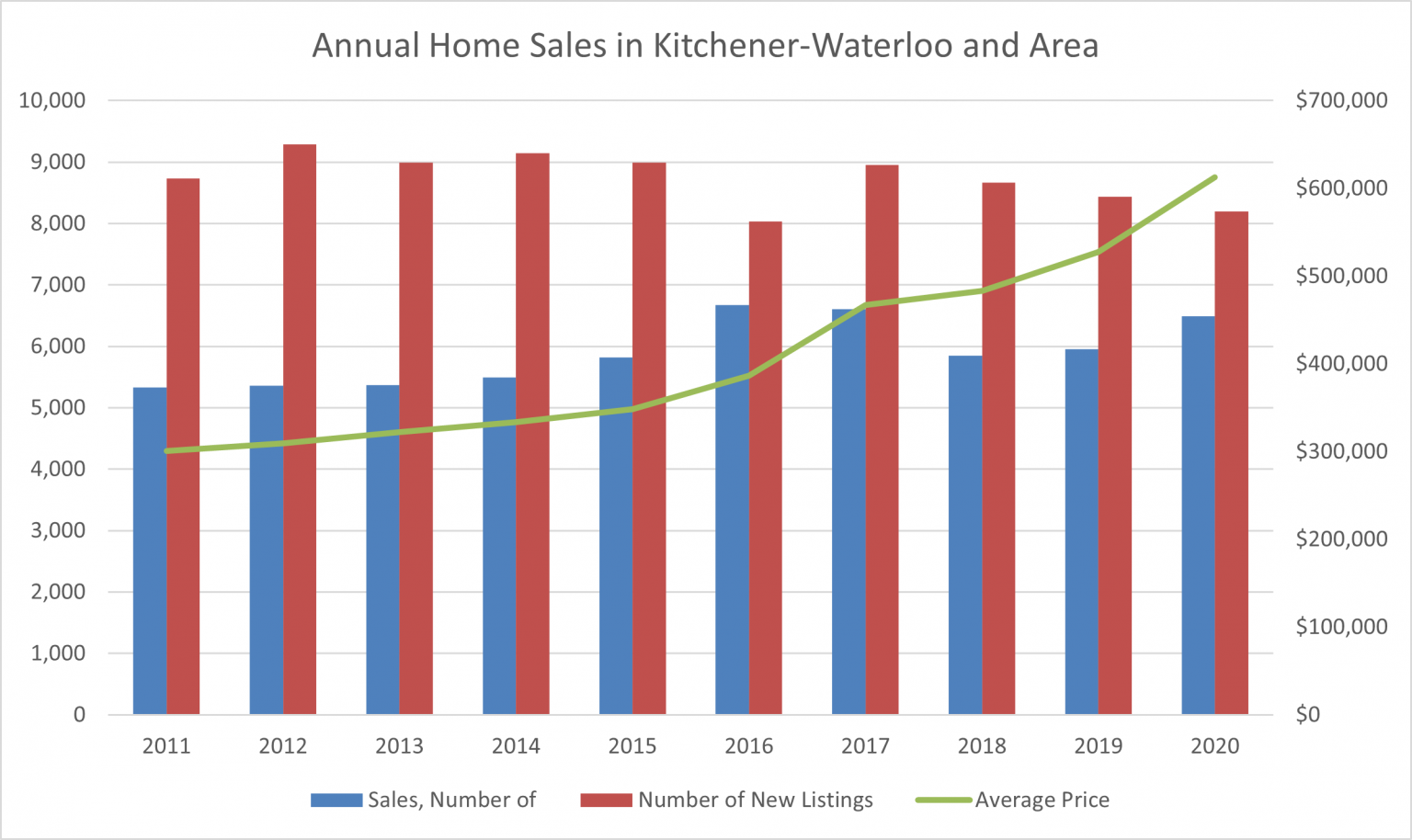
There were 6,492 residential homes sold through the Multiple Listing System (MLS® System) of the Kitchener-Waterloo Association of REALTORS® in 2020, an increase of 9 per cent compared to 2019. Compared to previous years, 2020’s annual sales were 5 per cent above the previous 5-year average, and 11.6 per cent above the previous 10-year average.


On a monthly basis, there were 42 per cent more home sales compared to last year, with 351 home sales in the month of December.


“December’s home sales were the highest on record for the month,” says Nicole Pohl, President of KWAR.  “This marks the sixth consecutive month of record home sales in Kitchener-Waterloo and helps propel 2020’s annual number of transactions over the 6,000-unit threshold for only the third time in our history.”


Total residential sales in December included 204 detached (up 46.7 per cent), and 63 condominium units (up 34 per cent) which includes any property regardless of style (i.e., semis, townhomes, apartment, detached etc.). Sales also included 20 semi-detached homes (down 9.1 per cent) and 64 freehold townhouses (up 68.4 per cent).


For 2020, total residential sales included 3,899 detached (up 8.1 per cent), and 804 condominium units (up 18.9 per cent) which includes any property regardless of style (i.e., semis, townhomes, apartment, detached etc.). Sales also included 450 semi-detached homes (up 6.8 per cent) and 1,346 freehold townhouses (up 7 per cent).


In December, the average sale price of all residential properties sold in 2020 increased by 14.4 per cent to $634,545 compared to 2019. Detached homes sold for an average price of $755,618 an increase of 11.9 per cent compared to 2019. During this same period, the average sale price for an apartment-style condominium was $383,196 for an increase of 5.4 per cent. Townhomes and semis sold for an average of $514,760 (up 27.7 per cent) and $574,659 (up 20.2 per cent) respectively.


On a year-to-date basis, the average sale price of all residential properties sold in 2020 increased by 16.1 per cent to $612,521 compared to 2019. Detached homes sold for an average price of $719,203 an increase of 16.9 per cent compared to 2019. During this same period, the average sale price for an apartment-style condominium was $391,698 for an increase of 13.7 per cent. Townhomes and semis sold for an average of $468,891 (up 14.6 per cent) and $520,753 (up 18.3 per cent) respectively.


The median price of all residential properties sold last year increased 17.3 per cent to $575,000 and the median price of a detached home during the same period increased 15.7 per cent to $660,000.


“Even well before the pandemic we had noted a trend of consumers migrating out of the GTA to our region,” says Pohl. “As the pandemic heated up it only fueled this fire more as the very concept of what home means was shifting. With more people working from home, some permanently, space has become a greater concern than ever before. When you combine this with all the other great attributes of our region, it is no surprise this occurred.”


Like many other parts of Ontario, low inventory has become a defining factor of Waterloo Region’s housing market and the new normal. The number of months of inventory remained at just 1 month or less throughout most of 2020.


For historical context, the number of months inventory in Kitchener-Waterloo between 2011 and 2015 averaged 4. Between 2016 and 2020 it was a monthly average of 1.5 months. The number of months of inventory represents how long it would take to sell off current inventories at the current rate of sales.


The average number of days to sell in 2020 was 16 days, compared to 23 days in 2019 and a previous 5-year average of 27 days.


Dollar volume of all residential real estate sold last year increased 26.5 per cent to $3.9 billion compared with 2019.


While the majority of residential MLS® System activity is properties for sale, REALTORS® are increasingly representing landlords and tenants. Last year 848 residential leases occurred through KWAR’s MLS® System, which is an increase of 13.9 per cent compared to last year.


“Looking to the year ahead, we should expect more of the same” predicts Pohl. “Real estate continues to be one of the shining lights supporting the Ontario economy, so we do not expect to see any significant efforts to try to cool the market. Buyers should continue to expect stiff competition in Waterloo Region, and for sellers, there will continue to be a strong interest for all properties entering the market. Active markets are difficult markets, but the only way for a seller to ensure they are getting the full market value of their home is through the level playing field of the KWAR MLS® System. For buyers, they should ensure they are working with a local REALTOR® to assist with the speed and challenges of this market”


Thursday, December 17, 2020

Good Debt vs. Bad Debt


A recent report from Statistics Canada shows that Canadian families now owe nearly $1.65, on average, for every dollar of after-tax income they earn. This is leaving many households vulnerable to economic shocks such as job losses, interest rate hikes or a sudden slide in house prices.

There is no such thing as good debt or bad debt. Debt is a debt, which means you owe somebody or some company money. Too much debt is never a good thing, be it good debt or bad debt. However, avoiding debt at any cost is not smart either if it means depleting your cash reserves for emergencies.

The challenge is learning how to judge which debt makes sense and which does not and then wisely managing the money you do borrow. The standard definition for good debt is debt that helps you to make more money, while bad debt is one that makes you poorer.

For example, when you use debt to finance consumable items, you aren’t accumulating good debt. Credit card debt is often considered bad debt because of the nature of items that credit cards are used to purchase. You should never accumulate debt to purchase everyday items like clothes or food. If you use a credit card for these types of purchases, you should pay the balance in full each month.

On the other hand, a home purchase can be considered good debt. Since homes usually appreciate in value, the mortgage loan you take out to pay for the home is an investment. Another example of good debt is a student loan taken out to finance a college education. Earning a college degree usually means that you’ll make more money over your lifetime.

There are some books which term car loans as one of the bad debts. The financing costs of a car are indeed high, coupled with depreciation of the car and maintenance makes car ownership a very expensive affair. However, if the car is the tool that helps you to make money, it’s a form of transportation to get you to various workplaces. Perhaps the fact that you own a nice car helps to build confidence in your clients so you can close more sales. Would it still be bad debt? Or is it now good debt?

Many times a good debt can turn into bad debt overnight. For example, a mortgage loan used to purchase a property which later crashed in value by 30%. The good debt was raised for an investment, but it turned into bad debt because now the house is worth less than the value of the housing loan you owe to the bank.

It’s usually a good idea to focus on paying off your bad debts first. Since they provide no value, they are more costly than your good debts. You should pay off credit cards and auto loans before tackling mortgages or student loans.

Some people consider using good debt to pay off bad debt, like getting a mortgage for $110,000 instead of $100,000 and using the extra to pay off credit card balances. This isn’t a good idea for several reasons. First, repaying debt with debt is never a good idea. Second, it ends up taking longer to pay off the mortgage than it would have otherwise. Third, the higher mortgage increases your monthly payments and the time it takes to build equity in your home. Use cash to repay debts, not more debt.

The key thing before incurring debt is to fully understand what the money from the debt is used to pay for and the impact it has on you financially in the long run. If the debt is used to purchase an asset, make sure that the utility or financial return from the asset is higher than the cost of debt. It is also important to ensure that you are not overleveraged where your borrowings exceed your assets or where you have trouble servicing the loans. Any debt which is taken after you are overleveraged is not advisable, regardless of its purpose.

The Hidden Costs of Home Ownership


Anyone who owns a home knows that there are many additional costs associated with owning a home. Many first-time homeowners base their decision to buy a home on their ability to make the monthly mortgage payments. In fact, there are many other costs that go into owning a home than just the mortgage payment.


First-time homeowners are often startled by the hidden costs of owning a home. The traditional housing expenses (principal payments, interest, taxes, and insurance) are just the beginning. Maintenance, repairs, supplemental insurance, home improvements and decorating can cost you thousands of dollars a year—more than you expect.

Additionally, a home purchase triggers a series of additional spending on appliances, furnishings, and remodeling activities that exceed typical spending levels of non-moving owners or renters and can persist for two years after moving.

Let's take a look at the most overlooked items that tend to be a burden to all homeowners:

Move-in Costs

1. Home improvement costs
Your new home may require some repairs or remodeling. One of the great things about being a homeowner is the opportunity to put your personal stamp on a house. It’s easy to go overboard with home improvements, though. Relatively few projects add much lasting value to your home, let alone guarantee that you will recoup your costs.

Homeowners are more inclined to purchase luxury items that renters would not, such as granite countertops, pricey fixtures, alarm systems, and other gadgetry. The cost of these luxury amenities can easily add thousands of dollars to the cost of owning a home.

2. Furnishing costs
You will also want to budget money for additional furnishings. Since your new home is likely to be larger than your apartment, you will probably need more furniture. You might also want window treatments, lighting fixtures, carpet or area rugs, and appliances, all of which can add up to tens of thousands of dollars.

Ongoing Costs

1. Monthly mortgage payment
Probably this is the easiest to understand. If you have selected a fixed-rate mortgage, your lender will tell you exactly how much your monthly payment is going to be.

2. Property taxes
Property taxes can be demanding because even if you've paid off the mortgage, you still have to pay a monthly fee to the town and/or the municipality in which you reside. It can easily total $500 to $1,000 or more a month, particularly in large cities where property values have soared in recent years.

3. Utility bills 
Monthly utility bills such as electricity, gas, and others could amount to $400 or more a month. Some current home renters may not be aware of this as it is most likely it is included with their monthly rent. If you are moving to a condominium, you should also add monthly condominium fees.

4. Maintenance costs
How much your home will cost you in maintenance and repairs depends on several factors: the age of the home, how well it’s been treated by previous owners, the harshness of your climate, and how much money you want to get out of your home when you sell it.

You should budget between 1% to 2% of your home’s value for annual maintenance. If you bought a $200,000 home, for example, you should set aside at least $2,000 a year, or around $200 a month. Some years you'll spend less, but in others, you could spend more. A new roof for your home, for example, can cost $4,000 or more.

Naturally, some homes cost more to maintain than others. Older homes usually need more maintenance than newer homes, even if it has been recently renovated. Also, don't assume that because a home is new, it won't need any maintenance for a while. All homes need to be attended to on a regular basis to keep them from falling into a state of disrepair.

The Bottom Line
Being a homeowner brings with it a great sense of pride and gives you enormous stability and security knowing that you will always have a roof over your head, however, it can cost a lot more than you think. So to avoid any unpleasant surprises, make sure you are aware of these extra costs.

Tips for Hiring a Remodeling Contractor

A remodeling project can be daunting and confusing but it's not a difficult task. You can easily search the web or look in the yellow pages and find many home remodeling contractors listed in your area. But the question is:  which one do you hire for your home remodeling project? Which one will perform quality work, charge a fair price, and get the job done on time? 

By following these tips you will make the selection process easier and be better prepared to make an informed decision that best suits your needs.

1. To reduce the risk of hiring the wrong home contractor you should first do a little preparation yourself for the home remodeling project. Sketch out and write down what you want to get done. Provide a copy of this information to the prospective home remodeling contractor as this will help to minimize misunderstandings of requirements.

2. Visit home improvement centers such as The Home Depot, and look at materials expected to be used on your project. Make note of their costs for you to compare material costs proposed by prospective contractors.

3. When you start to call prospective contracts ask for references and previous work that you can visit.

4. Employ a contractor with an established business in your area. Local firms can be checked through references from past customers in your community. Local contractors are compelled to perform satisfactory work for their business to survive.

5. Contact your local licensing agencies to ensure the contractor meets all requirements.

6. Check the contractor with the government's Consumer Affair Office and the Better Business Bureau to ensure there is no adverse file on record.

7. Ask to see a copy of the contractor's certificate of insurance for you to also ensure the contractor meets all specifications.

8. Make sure the contractor's insurance coverage meets all the minimum requirements. 

9. Be sure that the contract between you and the contractor states exactly what is to be done and how change orders will be handled.

10. Make as small a down payment as possible so you won’t lose a large sum of money if the contractor fails to complete the job.

11. Be sure that the contract states when the work will be finished and what action you can take if it isn’t. Also, remember that in many instances you can cancel a contract within three business days of signing it.

12. Ask if the contractor’s workers will do the entire job or whether subcontractors will do parts.

13. Be sure that the contract specifies that the contractor will clean up after the job and be responsible for any damage.

14. Guarantee that the materials used meet your specifications.

15. Don’t make the final payment until you’re satisfied with the finished job.

Whether you’re planning an addition to your home for a growing family or simply getting new storm windows, finding a reliable contractor is the first step to a successful and satisfying home improvement project. However, to find a good contractor, someone you can trust to do a good job for a fair price and stand behind his or her work could be hard. But if you do your homework and follow these tips, you will improve the odds of getting a contractor you will be happy with.


Celebrating the Holidays During the Pandemic


As the holiday season approaches, many families are debating whether to attend their annual celebrations due to COVID-19. And while this holiday season may look a bit different because of the pandemic, Parents very much want to allow their children to have as much of a normal childhood as possible during this pandemic, and maintaining holiday celebrations is part of that.

If you’re still feeling the holiday spirit, you can make this time of year just as special even while safely distanced. Here’s how.

Send Gifts.
Sending cards or gifts remains a relatively easy way to let loved ones know that you’re thinking of them. Who wouldn’t want to receive some home-baked goodies, a basket of fresh fruit, or a festive wreath? If you enjoy knitting, candle making, or other ways of crafting gifts for the holidays, now is the time to start planning for Thanksgiving through the New Year.

Share videos.
Your normal family visiting may often have music involved—with guitar, piano, and maybe some singing. You can make a few video recordings of songs and send them to others by text or email. If you don’t play the guitar or like to sing, you can still make your own holiday-themed videos, maybe share a dance routine, a demonstration of athletic skill, or even some stand-up comedy. The key is to have fun and let your imagination run free.

Plan a Zoom Party.
Before the pandemic, if someone couldn’t make a holiday gathering, we just missed them! 

Luckily, emerging technology is now available to help us meet remotely and reduce the burden of social distancing. You can use Zoom to host an online party, sing Christmas carols together, or share a meal and good conversation remotely with friends and family members, whether they live nearby or across the country.

Take a virtual group walk.
Due to the physical demands and psychological impacts of the COVID-19 pandemic, it’s been difficult for many of us to stay physically active. The key is making exercise a daily priority, and the holidays are no different.

After your holiday meal, go on a virtual group walk through your respective neighbourhoods to work off the food. Thanks to your smartphone’s camera, you can share your time outdoors and all of the interesting sights along the way. 

Stay Safe.
The safest way to celebrate or enjoy the holidays is with members of your immediate household. Your household is anyone who currently lives and shares common spaces in your housing unit. This can include family members as well as roommates or people who are unrelated to you.

If you plan to go ahead and join a holiday gathering in person, it’s important to remain vigilant. Remember there are risks associated with travel and interacting with people. Try to keep any gatherings brief and relatively small, about six people or less. If the weather permits, hold the get-together outdoors.

To protect yourself and your loved ones, follow advice from your local public health authority, and remember these 3 W’s:

  • Wear a mask when you are out in public and when you are indoors with people who are not part of your immediate household. The only exception is while eating or drinking!
  • Watch your distance, staying at least 6 feet away from people who are not part of your immediate household.
  • Wash your hands thoroughly and frequently.

Wishing each of you a wonderful and healthful holiday season.

Friday, December 4, 2020

5th Consecutive Month of Record Home Sales in Kitchener - Waterloo ... How does your home compare?

November home sales

 KITCHENER-WATERLOO, ON (December 3, 2020) ––There were 575 residential homes sold through the Multiple Listing System (MLS® System) of the Kitchener-Waterloo Association of REALTORS® in November, marking another record-breaking month of homes sold in the Kitchener-Waterloo area. November’s home sales represented an increase of 35 per cent compared to the same month last year, and a decrease of 17 per cent compared to the previous month. The previous ten-year average number of residential sales for November is 433.


November is the fifth consecutive month of record home sales in the Kitchener-Waterloo area.


“We are now well beyond any pent-up demand from the first lockdown,” said Nicole Pohl, President of KWAR. “Now we’re simply dealing with straight-up demand for our community as an attractive place to put down roots, and the current COVID-19 pandemic is only further fuelling the already hot market and elevating Waterloo region as a desirable place to own a home.”


Total residential sales in November included 341 detached homes (up 28.6 per cent from November 2019), and 82 condominium apartments (up 60.7 per cent). Sales also included 112 townhouses (up 53.4 per cent) and 40 semi-detached homes (up 5.2 per cent).


The average sale price of all residential properties sold in November increased 13 per cent to $637,336 compared to the same month last year, while detached homes sold for an average price of $753,641 an increase of 14.4 per cent. During this same period, the average sale price for an apartment-style condominium was $400,882 for an increase of 12 per cent. Townhomes and semis sold for an average of $482,901 (up 8.6 per cent) and $562,988 (up 30.4 per cent) respectively.


The median price of all residential properties sold in November increased 16.5 per cent to $600,000 and the median price of a detached home during the same period increased 15 per cent to $685,000.


“Prices continued to climb in November as buyers across all price points compete for listings as soon as they come on the market,” said Pohl. “The number of available properties going up for sale simply can’t keep up to the number of people wanting to purchase them.”


There were 584 new listings added to the MLS® System in KW and area last month, an increase of 34.8 per cent compared to November of last year, and 13 per cent more than the previous ten-year average for November.


The number of Months of Supply (also known as absorption rate) continues to be very low at just 1 month for the month of November. The previous ten-year average supply of homes for November was 3 months, and in the past 5 years, the average supply for November was 1.8 months.


KWAR’s president says the sales-price-to-list-price ratio for all residential properties sold in November was 107.9 per cent. “The only other time I’ve seen the sale to list ratio this high was in May of 2017 when it hit 108.6 per cent,” says Pohl.  For comparison, in 2019, the monthly close price to list price ratio was at or near 100 per cent from January through to December. Since August it has been over 105 per cent.


With competition this fierce, Pohl says working with a local REALTOR® has never been more important.


The average number of days to sell in November was 14 days, compared to 28 days in November 2019.