Thursday, September 26, 2019

Tips to Avoid Overspending

CONTACT ME AT WWW.KIMLOUIE.NET FOR A FREE HOME VALUE REPORT!


Do you have significant debts as a result of overspending? If you do, you are not alone. Modern society makes it particularly easy to spend more than we really should. However, if you want to clear your debts and have greater peace of mind, it is important to tackle the root cause, which is overspending.
Overspending can be an indicator of a deeper issue as well and therefore, it should be addressed properly. This article suggests some useful tips to help you know how to avoid overspending.
1. Accept that a problem exists
In order to seek a solution to something, you must accept that the problem exists. Try to decipher the reasons behind your overspending. Identify situations that make you overspend. Understanding the root cause of your behaviour will assist you in finding a workable solution to your extravagant ways. People tend to hide and ignore such issues as if they don’t exist at all. Your refusal to admit that you overspend will never let you conquer your shopping impulses.
2. Be aware of how much money you spend
Many chronic spenders live in denial about how much they spend. If you realize how much you spend on various items, this alone may be sufficient to reduce your spending. Keep a log of your daily spending, or go through your bank accounts, credit card statements and add up how much you spend on different items and decide whether you really want to spend that much money.
3. Set a financial limit
If you really have trouble controlling your spending it will be very effective to give yourself strict amounts of spending per week. This will work most effectively with cash because it is easier to monitor. If you learn to live on a limited amount per week, you will value money more and learn more frugal habits.
4. Plan your purchases ahead of time
Planning ahead can really help with grocery shopping and buying gifts. You can actually take advantage of sales and only buying things that you really need.
5. Avoid impulsive purchases
Make an effort to have a moment of reflection before buying anything. If you see something you would like to buy, try waiting a day before actually committing yourself to making the purchase. If you really want it, you will come back. This also gives you the chance to find other things that may be better.
6. Do comparison shopping
As prudent spenders, comparison shopping is a prerequisite to smart spending. With great tools online, it is getting easier and faster to comparison shop. Make a habit of searching newspaper flyers for your weekly grocery items.
7. Use cash – avoid credit cards
Avoiding credit cards helps in overcoming the impulse of overspending. You should carry only the amount you intend to spend. This, in turn, prevents you from indulging in unnecessary purchases and expenses.
8. Avoid spending by habit
Quite often a lot of our spending is a daily habit. However, this spending could easily be unnecessary. For example, if you buy takeout coffee every day, why not invest in a coffee machine. Just because you spend $10 a day on lunch doesn’t mean this habit has to continue forever. Try taking your own lunch. Re-evaluate all your habitual spending patterns and decide whether it is necessary.
9. Reward yourself on every success
Make sure that you reward yourself with a lucrative incentive every time you control an urge to shop. Encourage yourself to exercise restraint. Every success over compulsive spending calls for a pat on your back and is worth an enticing reward so that you can bring yourself to avoid overspending the next time. Make sure you don’t head off to the market to reward yourself, or the entire purpose will be defeated.
10. Get help
If you are unable to control your spending impulse, then you must admit this drawback and accept help from your spouse or relatives. Ask them to help keep control over you so that you do not spend more than required.
In addition, you need to start valuing money and the hard work that goes in earning it. This thought and understanding will help you spend money in a responsible way.

Before Buying, Be Sure to Check Out Some Open Houses!


CONTACT ME AT WWW.KIMLOUIE.NET FOR A FREE HOME VALUE REPORT!


Open houses are the gold standard in real estate. They’ve been around for decades and will be ingrained in the buying and selling of homes for years to come. But as a buyer, are you making the most of your open house visits?
To get the most out of an open house visit, follow these guidelines:

Use the open house to learn about the market without committing
Even if you’re not serious about moving, viewing a few properties in a neighbourhood you like is a great way to get a sense of the market. Who knows? You might stumble upon your next dream home!

New buyers should leverage the open house opportunity to get a feel for the market. Most open houses will have a handout available containing the list price and other property information. Be sure to keep a copy.

Ask the agent questions
Explore the entire property, including the backyard. Don’t be shy about asking the listing agent questions about the property and the neighbourhood.

• Ask about the area. Are there schools nearby? Where is the nearest park or playground located?

• Ask about potential required repairs and renovations. For example, if the furnace is more than 15 years old, it may need to be replaced soon.

• If it’s a competitive market, ask questions such as: “Why is the seller selling?” “Is there a certain day to review offers or have you had a lot of showings?” In a slow market, ask how long the property has been on the market and what the seller’s motivations are. A good agent will engage you because it’s good for his seller.

Many agents are eager to quiz open house attendees about their home-buying plans. "How long have you been looking for a home? Are you working with an agent? Are you pre-qualified for a mortgage?" they ask. Why not turn the tables? An open house can be an opportunity for you to pump a local agent for some information about for-sale homes and the housing market.
Watch the other buyers
You can tell a lot about the activity and marketability of a home by watching the other buyers. If you observe a lot of people walking in and out quickly, the home probably has some issues. Are the buyers hanging around, asking questions of the listing agent and huddling in the corner talking to their spouses or partners? If so, it could be a sign this is a well-priced and “hot” listing. If you’re interested too, observing other buyers at the open house could help you learn about the competition.

Finally, walk around the neighbourhood. Try to get a sense of what it’s like to live there. If possible, chat with a neighbour.

If you become interested in the home, be sure to advise the listing agent that your own REALTOR® will be following up. Otherwise, the listing agent might assume that he or she will be representing you.

When to refinance your mortgage?


CONTACT ME AT WWW.KIMLOUIE.NET FOR A FREE HOME VALUE REPORT!

Since interest rates are at a 40-year low, switching to a lower rate may save you a lot of money – possibly thousands of dollars per year. There are penalties for paying your mortgage loan out prior to renewal, however, these could be offset by the extra money you save through a refinance.

What's your goal? Before deciding whether or not to refinance, you need to determine what you want to accomplish. Remember, a refinance doesn't pay off the debt; it just restructures it, often at a lower interest rate and a different loan term than the current mortgage.
1- Reducing the interest expense is the most common goal of a refinance. But some homeowners also appreciate the ability to extend the loan back out to 30 years, reducing the monthly payment.
2- Debt consolidation is another goal of refinancing. If you have both a first mortgage and a home equity mortgage, combining the two mortgages into one fixed-rate mortgage levels out the payment over the loan term.
3- Getting cash from your home. The equity you have in your home can act like a savings account that you could access through a home equity loan or a cash-out refinance. This is usually done when you want to finance an important home improvement, pay for college or pay off high-interest credit card debt. Whatever your reason, this may be the right option for you.
When to refinance?
After determining your reasons for refinancing, you need to consider whether the timing and circumstances make this the right time to get a new mortgage.
You may be better off to stay with your current mortgage. For example, if your current mortgage has a high prepayment penalty or if you plan to move from your home in the next few years or when the monthly savings gained from lower monthly payments may not exceed the costs of refinancing.
As a rule of thumb, it pays to refinance if you can get an interest rate at least two percentage points lower than what you are currently paying. Asking yourself a few questions may help you determine if you can save money:
  • How much can I lower my current monthly payment? 
  • How long do I plan to stay in the house after I refinance?
  • How much will I pay in refinancing costs? 
How to refinance?
Refinancing is similar to the process you encountered when you closed on your first mortgage. It requires an application, credit check, new survey, and title search, as well as an appraisal and inspection fees. As you know, this process can be quite lengthy and expensive.
Keep in mind, however, that by refinancing you may extend the time it will take to pay off your mortgage. That said, there are many ways to pay down your mortgage sooner to save you thousands of dollars. Most mortgage products, for instance, include prepayment privileges that enable you to pay up to 20% of the principal per  calendar year. This will also help reduce your amortization period (the length of your mortgage), which in turn saves you money.

Thursday, September 5, 2019

AUGUST HOME SALES EASE AS PRICES CONTINUE TO RISE ALONG WITH DEMAND


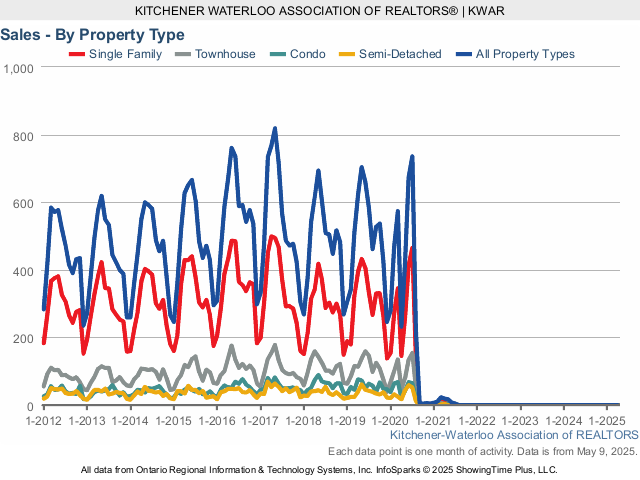
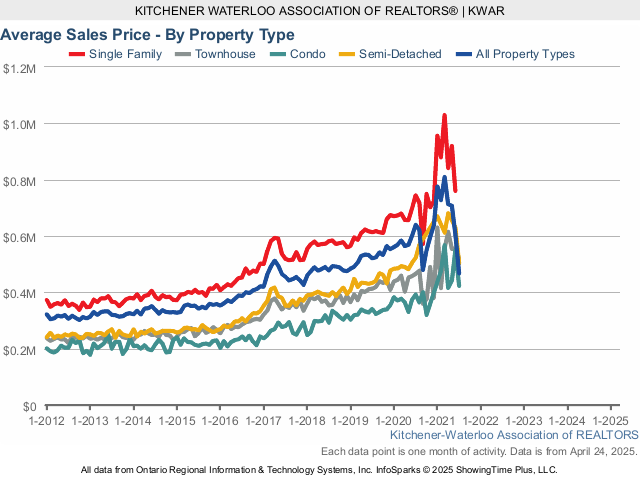
459 residential properties sold through the Multiple Listing System (MLS® System) of the Kitchener-Waterloo Association of REALTORS® (KWAR) in August, a decrease of 9.1 per cent compared to the same month last year.    


Home sales in August included 267 detached (down 11.9 per cent), and 56 condominium apartments (down 13.8 per cent). Sales also included 97 townhouses (down 4.9 per cent) and 39 semi-detached homes (up 11.4 per cent).

“The number of homes sold last month was below the average for August; however, we continue to see strong price gains across all property types,” says Brian Santos, KWAR President.

The average sale price of all residential properties sold in August increased by 6.4 per cent to $524,482 compared to August 2018. Detached homes sold for an average price of $615,568 (an increase of 5.4 per cent compared to August of last year. During this same period, the average sale price for an apartment-style condominium was $324,778 for a decrease of 3.1 per cent. Townhomes and semis sold for an average of $420,239 (up 18.3 per cent) and $441,802 (up 10.2 per cent) respectively.

The median price of all residential properties sold last month increased 8.1 per cent to $495,000 and the median price of a detached home during the same period increased by 2.8 per cent to $560,000.

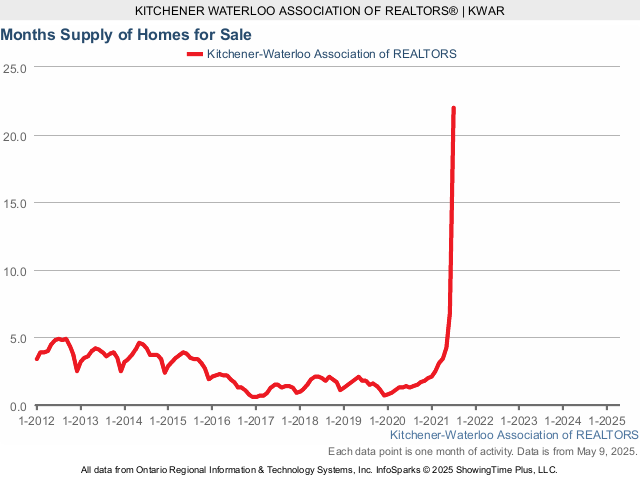
REALTORS® listed 574 residential properties in K-W and area last month, a decrease of 14.5 per cent compared to August of 2018, and a decrease of 13 per cent in comparison to the previous ten-year average for the month of August. The total number of homes available for sale in active status at the end of August totalled 734, a decrease of 17.3 per cent compared to August of last year, and well below the previous ten-year average of 1,426 listings for August. Months Supply of Homes for sale stood at 1.5 months in August, which is 16.7 percent lower than the same period last year.

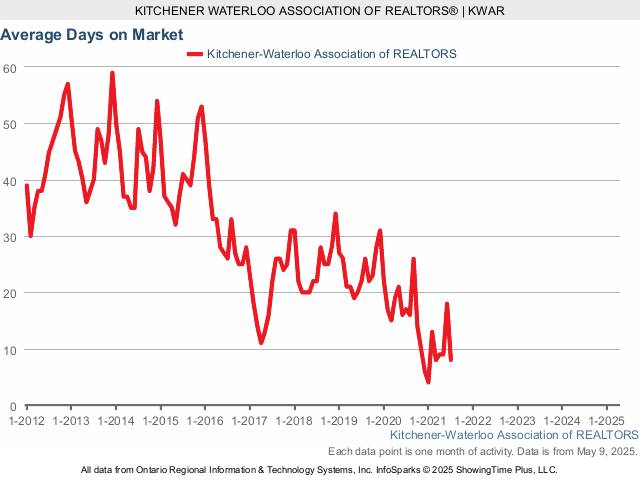
The average days it took to sell a home in August was 26 days, which is two days fewer than it took in August 2018.

“We’re noting differences in market balance depending on the price range,” says Santos. “For homes priced under $600 thousand, it is still a strong seller’s market, whereas above $600 thousand, it is a more balanced situation.”

As an indicator, Santos points to the month’s supply of homes, also known as the absorption rate. For homes priced at more than $600,000, the months of supply stood at 3.4 in August, compared to 0.9 months for homes prices under that amount. Months supply is the inventory of homes for sale at the end of a given month, divided by the average monthly closed sales from the last 12 months. The previous ten-year average months supply across all price ranges has been just over 3 months.

“It all comes down to what the buyers can find in their price range,” says Santos. “Homes in Kitchener-Waterloo are definitely in high demand, and there is strong competition among buyers trying to find one that will suit them.”

Santos advises buyers to work with a local REALTOR® who has a complete understanding of our region to give them an advantage in this crowded KW housing market.


Wednesday, August 14, 2019

An Old House... Money Pit or Diamond in the Rough?


Contact me at www.kimlouie.net for a Free Home Value Report!
 
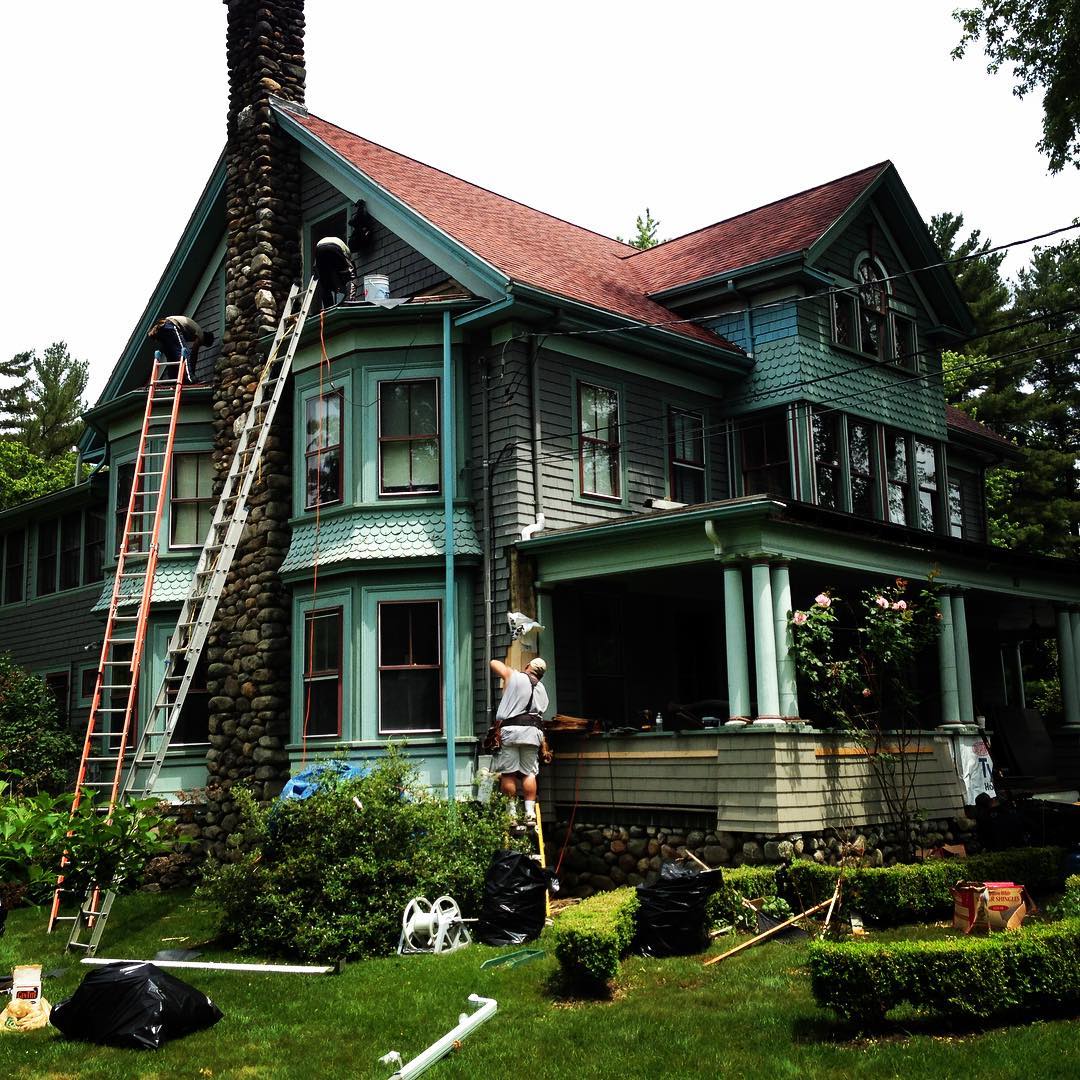
It's like a love affair; some older homes make your heart skip a beat! It is hard not to fall in love with an older home’s historic unique architecture, gabled roofs, hardwood floors, crown moldings, and antique light fixtures—older homes definitely have their charm.
The plastered walls, leaded glass windows, original chandeliers, and oak paneling make an old home as attractive as it can possibly be. If you found your love you should be aware of the following money pitfalls of old houses. You do not want to discover that beneath the surface of your dream home lays a dilapidated wreck.
This article provides you with some valuable tips to help you identify potential problems and some renovation rules, should you decide that this love affair is going to be your Gold Mine.
Foundation 
The foundation is the most important aspect of any home, especially for older ones. One problem that is common for older homes is called the “sulfate attack”. This can occur as a result of a chemical reaction between the soil and the concrete, which causes the foundation to crack and crumble and that can be very problematic. Another major concern with older homes is that the center beam of the home can begin to sink. This can result in a sagging roof, bowed walls, and sloping floors. If the old house has a bad foundation then renovating it can be very expensive where the cost can range from several thousand dollars to $50,000 depending on the size of the home. Also, in some cases, one might need to jack up the house to replace the foundation and shore up the centre beam.
Electrical Wiring 
When buying an older house, it is very important to find out if there are any problems with the state of the electrical and lighting system. Do the lights flicker? Is the current steady or do the lights fluctuate between bright and dull? Is there adequate lighting in the home? It’s important to have the wiring carefully inspected. Also, many older houses use aluminum wiring, which is cheaper than copper wiring but it is a serious fire hazard. Ensure that you factor the cost of rewiring into your offer price. Also, you should consider whether there are enough outlets in the home to suit the needs of a modern household. Install more outlets in order for you to run a number of devices at once like television, computer, stove, etc.
Lead Paint 
In older homes, lead paint is very common as lead was used as a white pigment in paint until the mid-1950s. If you are planning to repaint the home, call in a professional renovation firm as they know the safety precautions needed to be taken when repainting the house. Children and pregnant women should not be in the home during renovations.
Asbestos 
Asbestos is a mineral that makes a very effective fire and heat-resistant material that was discovered to cause lung disease. When the tiny particles of this mineral are inhaled, over a period of years they begin to damage the tissue of the lungs. In old homes, asbestos was used in carpet underlay, textured paints, roofing felt, electrical wiring insulation, acoustic ceiling material, and insulation. Getting the house checked for asbestos is very critical.
Galvanized Pipe 
Galvanized pipes are known to rust very quickly. Most insurance companies now refuse to cover water damage caused by leaks in a home with galvanized pipes.
Condition of the Older Home 
Just like people, years will eventually take a toll on homes as well. An older home may begin to sag and slope, which is why it's very important to know about the conditions of the house you’re planning on purchasing.
Older homes may be beautiful, but they aren't designed for modern living without a total update or upgrade. Make sure the house structure can be modified easily to suit a current living style.
For older homes, renovations are a challenge. To determine the price you are willing to pay, add up the estimated costs to renovate the property based on a thorough assessment of the house. Then, subtract that from the home's market value after renovation. Allow for an additional 5% for cost overruns and unforeseen problems plus inflation.

Preserve the Charm of Your Old House
If you have already fallen in love with this old house, then make sure you follow the golden rules in repairing your dream home and preserve its historic features and value.
  1. The golden rule of remodeling is, "do no harm". As you update your older home, make sure to preserve its historic details. Reuse existing materials. Keep historic moldings and hardware. Wire gas lamps for electricity. Keep distinctive examples of craftsmanship. Restore marbling, stenciling, and carvings.
  2. Don't try to undo long-ago renovations. Most buildings change over time, and alterations to your house may have a historic significance in their own right.
  3. Whenever possible, repair rather than replace. Don't throw away that old claw foot bathtub—have it re-glazed. Fix damaged doors, refinish old cabinets and patch cracking plaster.
  4. If historic features cannot be repaired, look for a similar item at an architectural salvage centre, or buy a new item that matches the old in design, colour, texture, and other visual qualities.
  5. And best of all make sure you hire a contractor that shares your passion and understands your love affair with your old house.
Good luck, you may have found your Gold Mine.

What is a Mortgage Pre-Approval?


Contact me at www.kimlouie.net for a Free Home Value Report!
 
Securing a mortgage pre-approval is one of the first steps to take before beginning your house hunting process. A pre-approved mortgage is a tentative promise from a lender that it will loan you a certain amount of money for the purchase of the real estate, for a certain term and at a certain interest rate. The lender will base its decision upon your income, credit score and assets.
A pre-approval is not a binding commitment, but rather an indication that the lender is willing to extend a mortgage to an applicant once a suitable property has been found and secured via a real estate contract. It is usually valid for 90 to 120 days. The final decision is generally subject to certain conditions being met before the mortgage is finalized such as the appraisal of the real estate is high enough to protect the lender in the case of default, the property title is clear and the property meets inspection standards, plus a number of other factors.
Even though you have been pre-approved by a lender, it is best practice to include a condition of financing in the purchase agreement to give you time to gather your documents and the lender time to review and give final approval to your application. Once you have a signed purchase agreement, the lender will require written income verification and proof of down payment, as well as proof the title is clear, the property meets inspection standards, and the appraisal of the property is high enough to protect the lender in case of default.
Advantages of a Pre-Approved Mortgage
1. Knowing what you can afford
Knowing how much you are able to spend before purchasing a home is always a good idea. With a pre-approved mortgage, you know exactly where you stand before shopping for a home.
Many real estate agents will want you to have a pre-approval in place before they take you house hunting. This is to ensure that they are showing you properties within your affordable price range. As a general rule, your housing costs, including your mortgage payment, taxes, and heating expenses should not exceed more than 32% of your gross household monthly income.
2. Pre-approval makes buying more convenient
If several buyers are interested in the same property, being pre-approved can give you the advantage. Sellers are more likely to accept an offer from a buyer who has been pre-approved over a buyer who has no guarantee that they can attain the financing for the amount they offered.

Condo "Occupancy Fees" Explained


Contact me at www.kimlouie.net for a Free Home Value Report!
 
Whenever you purchase a new condo, there is a period of time between when you take occupancy of your unit and when you take ownership of your unit. This is known as the ‘occupancy period’ or ‘interim occupancy’. During this period you will be requested by the developer to pay occupancy fees or ‘phantom rent’ as it is also known.
The Condominium Act requires condo developments to be constructed to a substantial level prior to registration of the condominium plan. Title to a unit cannot be transferred until the condominium is registered.
Thus, with newly built condominium apartments, there are two “closings”. The “interim closing”, occurs at the time of occupancy and the “final closing”, occurs at the time of final registration.
The process works something like this; the developer undertakes to build a condo development by submitting a site plan with the Municipality. When the Municipality registers this site plan it becomes a “Registered Site Plan”, setting out exactly what the developer is promising to deliver.
The developer then sells the suites as “pre-construction”; based on floor plans, brochures, etc. Once the developer sells enough units, say 60% or more, they start the construction while continuing to sell the units.
When construction is completed, the municipality verifies the building to be in accordance with the registered site plan and issues the “Occupancy Certificate”. The developer starts to contact all the buyers notifying them of their occupancy date, at this stage your unit is ready and liveable; you take possession of it, but not ownership. This is the first or “Interim Closing”.
Since the buyer’s down payment is deposited into the lawyer’s trust account, the developer does NOT receive any money until the building registers (final closing), a process that normally takes 4-6 months.
Until such time you must pay the developer “occupancy fees” for the right to live in the unit. The amount of the occupancy fees is roughly equivalent to the interest on the amount outstanding on the purchase price. For example, a $300,000 condo with 25% down means you must pay monthly occupancy fees roughly equal to interest payments on $225,000.
When the municipality completes its process and registers the building, the second or “final closing” take place. This is where the purchasers receive title to their property and their mortgage payments start, and this is when the developer gets his money.
During the occupancy period, the buyers undertake a portion of the developer’s mortgage, also called “Phantom Mortgage”, which is equal to their proportionate share of the overall condo.
The occupancy period is normally 4-6 months, but the higher up you are in the building, the shorter the occupancy period will be. So if you buy a unit on the ground floor, you can expect a long occupancy period. If you buy the penthouse, you will likely have a very short occupancy period.
There is no way to say absolutely how long the occupancy period will be. In most cases, the length of the occupancy period depends on the experience level of the developer. Experienced developers who are familiar with the process and have diligent lawyers working behind the scenes for them know how to build and how to register a building as quickly as possible.
It is in the developer’s best interest to register the building as quickly as possible and to have the occupancy period as short as possible. This is because they don’t get their money from the banks until the building is registered and all the unit owners have their mortgages commence.
The “Occupancy Fee” is made up of three components and is roughly equivalent to the:
  1. interest calculated on a monthly basis on the unpaid balance of the purchase price 
  2. the monthly maintenance fee contributed for the unit; and
  3. a factor for property tax
In total it will be about the same amount as if you took a mortgage. But you cannot get a mortgage because there is no “Title” to the property, thus banks cannot issue a mortgage.
Occupancy fees will be paid to the developer when you purchase a new condo, it does not apply for re-sale condos.
The purchaser can avoid paying the interest portion of the occupancy fee should he/she elect to pay the full balance of the purchase price owing on the date of occupancy. However, in order to do this, the purchaser or his lawyer must request this during the 10-days rescission (or cooling-off) period.
In all the cases it is left to the developer to include or exclude any of the above components in the occupancy fee, as long as this is made clear in writing and disclosed in the developer’s disclosure documents.