Thursday, March 5, 2026

The Wilmot Gamble: Industrial Ambition vs. Residential Realities


[HERO] The Wilmot Gamble: Industrial Ambition vs. Residential Reality

There's a fascinating contradiction playing out right now in Waterloo Region, and if you're a property owner, investor, or developer, you need to understand what's happening beneath the surface.

While the Region has effectively frozen new residential development approvals in Kitchener, Waterloo, and parts of Cambridge due to water capacity constraints at the Mannheim Wastewater Treatment Plant, they're simultaneously moving forward with an aggressive 770-acre industrial land assembly in Wilmot Township, one they're billing as a potential $10 billion economic catalyst.

I'm not here to tell you this is inherently good or bad. What I am here to do is break down what this strategic choice means for property values, development opportunities, and the long-term growth trajectory of our region.

The Numbers Behind the Bet

Let's start with what we know. The Region of Waterloo has been actively acquiring prime agricultural land in Wilmot Township, specifically in the New Hamburg area, for future industrial and employment uses. According to Regional Council meeting minutes from late 2025, the goal is to create a large-scale employment corridor that could attract advanced manufacturing, logistics, and technology companies.

The "$10 billion investment" figure has been floated by regional economic development officials as the potential private-sector capital this land assembly could attract over the next 15-20 years. To put that in perspective, that's roughly equivalent to the entire annual GDP of Waterloo Region's manufacturing sector.

Aerial view of fertile Wilmot farmland adjacent to industrial development site in Waterloo Region

The land itself represents some of the most fertile agricultural soil in Ontario, Class 1 and 2 farmland that's been in agricultural production for generations. The Region's strategy is to transition this land to serviced industrial lots, complete with water, wastewater, roads, and utilities infrastructure.

Here's where it gets interesting: while residential developers are being told "we don't have the water capacity," industrial development is being prioritized because commercial and industrial users generally consume significantly less water per acre than high-density residential.

The Resource Priority Conflict

This is the core tension I want you to understand, because it's going to shape property investment decisions for the next decade.

Waterloo Region is making a calculated bet that jobs growth will drive regional prosperity more effectively than housing growth in the short term. The thinking goes like this: attract major employers, create high-paying jobs, generate commercial tax revenue, and then use that revenue to fund the infrastructure upgrades (including expanded water treatment capacity) needed to unlock residential growth later.

It's a "jobs first, housing second" strategy.

The problem? We're already dealing with a housing affordability crisis. According to the Canadian Real Estate Association, the benchmark home price in Kitchener-Waterloo reached $697,400 in January 2026, while the Region's own housing needs assessment projects we'll need approximately 70,000 new housing units by 2031 to keep pace with population growth and household formation.

If you freeze residential development while population continues to grow (both through natural increase and employment-driven migration), you're creating upward pressure on housing prices and rents.
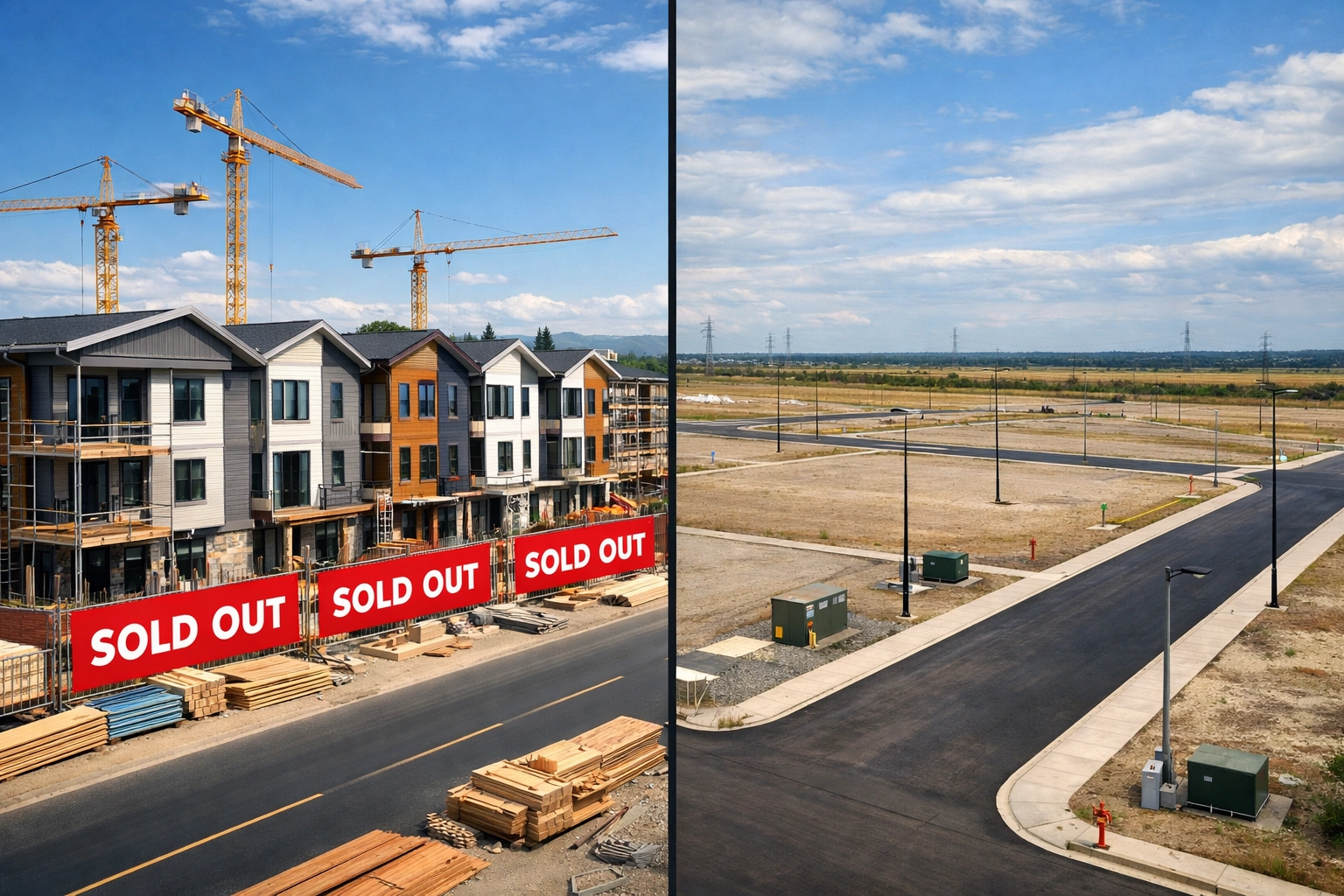
Sold-out residential townhomes contrasted with empty serviced industrial lots in Waterloo Region

From a pure real estate investment perspective, this creates what I call "manufactured scarcity." Properties with existing development approvals, servicing agreements, or grandfathered zoning in Kitchener, Waterloo, and Cambridge just became significantly more valuable. If you own a residential development site with water allocation already secured, you're holding an increasingly rare asset.

What This Means for Rural Property Values

Here's where most people aren't paying attention, but should be: the Wilmot land assembly is fundamentally changing the calculus for rural property owners throughout the township.

Traditionally, farmland in Wilmot has been valued based on agricultural productivity, essentially, what can you grow on it and what's the per-acre rental rate for cash crop farmers? That valuation model is being disrupted.

Once the Region begins servicing this 770-acre employment corridor with municipal water, wastewater, and roads, every adjacent property owner is going to start asking: "When does my land get redesignated? When do I get access to services?"

We're already seeing speculative purchasing activity. According to land registry data I've reviewed, there have been at least a dozen farmland transactions in Wilmot Township in the past 18 months where the purchase price significantly exceeded agricultural value, clear indication that buyers are betting on future employment land conversion.

But here's the risk: not every adjacent parcel will be redesignated. The Region has been explicit that this is a contained employment area, not a blanket rezoning of rural Wilmot. Property owners who purchase at "development speculation" prices but never receive employment land designation could be holding overpriced farmland for decades.

The Infrastructure Funding Gap

Let's talk about the elephant in the room: how is the Region paying for this?

The servicing costs for a 770-acre employment corridor are substantial, we're talking $150-200 million minimum for roads, water, wastewater, stormwater management, and utilities. Traditionally, these costs would be recovered through development charges paid by the companies building facilities on the land.

But here's the complication: under Bill 23 (the More Homes Built Faster Act) and subsequent provincial legislation, Ontario has significantly reduced the development charges municipalities can collect, particularly for residential but also for some commercial and industrial development.

Wilmot Township farm property with development potential sign near municipal infrastructure

According to the Region's 2025 budget documents, they're projecting a $47 million shortfall in development charge revenue over the next five years directly attributable to provincial legislative changes. That means servicing costs for major projects like the Wilmot employment lands will need to come from property tax increases, reserves, or debt financing, all of which have implications for existing property owners and taxpayers.

If you're a residential property owner in Kitchener, Waterloo, or Cambridge, you need to understand that your property taxes are likely subsidizing infrastructure that primarily benefits industrial development in Wilmot. That's not a value judgment, it's an accounting reality.

The Long Game: What Happens in Five Years?

Here's my professional assessment of where this is heading:

Short term (2026-2028): Expect continued upward pressure on residential property values in Kitchener, Waterloo, and Cambridge as development constraints remain in place. Purpose-built rental and intensification projects with existing approvals will command premium pricing. Rural residential properties in Wilmot (estate homes on agricultural land) will see increased interest from buyers priced out of urban markets.

Medium term (2028-2031): If the Wilmot employment lands successfully attract one or two anchor tenants (think large-scale advanced manufacturing or logistics operations), you'll see rapid land value appreciation throughout the corridor. Adjacent commercial and mixed-use development will follow. However, if the employment lands fail to attract tenants, a real possibility given global economic uncertainty, the Region will be sitting on expensive serviced land generating minimal tax revenue.

Long term (2031+): Assuming the employment strategy succeeds and generates the projected tax revenue, the Region will finally have the fiscal capacity to fund expanded water treatment infrastructure. At that point, you'll see residential development constraints gradually lifted, releasing pent-up housing supply. Property owners who purchased during the constrained period will likely see significant value realization.

What Should You Do With This Information?

If you're an investor or property owner in Waterloo Region, here's my practical advice:

For residential property owners: Understand that your property's scarcity value is temporarily elevated. If you're considering selling in the next 2-3 years, market conditions favour sellers. If you're buying, focus on properties with existing development potential or locations near planned rapid transit.

For rural landowners in Wilmot: Don't assume your farmland will automatically be redesignated for employment use. Have a clear conversation with a land use planning consultant before making purchasing decisions based on speculation. If your land isn't immediately adjacent to the designated employment corridor or doesn't have reasonable access to future services, agricultural valuation is probably still the appropriate baseline.

For developers: Properties with secured water allocation and development approvals in Kitchener, Waterloo, and Cambridge are premium assets right now. If you're sitting on entitled land, this is a strong market to advance projects. If you're looking to acquire, understand that you may be buying into a 5-7 year hold before servicing constraints are resolved.

The Wilmot land assembly represents a significant strategic gamble by Waterloo Region, one that prioritizes jobs and commercial tax base over immediate housing needs. Whether it pays off will depend on global economic conditions, the Region's ability to attract anchor tenants, and the political will to fund infrastructure expansion when residential development pressure becomes unsustainable.

What's certain is this: the next five years will create winners and losers in Waterloo Region's property market. The winners will be those who understood the infrastructure constraints and positioned themselves accordingly.

If you're trying to navigate these market dynamics, whether you're buying, selling, or holding, let's have a conversation about your specific situation and how these regional trends impact your property decisions.


Kim Louie, Real Estate Broker partnered with Coldwell Banker Peter Benninger Realty | Your Waterloo Region Real Estate Resource
📲 519.573.0837
📧 realtorkimlouie@kimlouie.net
💻 www.kimlouie.net

*** Not intended to solicit clients under contract. Content is for informational purposes and not guaranteed nor warrantied ***


Choosing Outdoor Lighting for Curb Appeal and Safety


Well-executed exterior lighting can enhances the architectural detail of your property and makes your home look beautiful in the evening adding an abundance of curb appeal.   Aside from aesthetics, good exterior lighting can give you and your guest’s added security and peace of mind when entering and leaving your home.


Much of the success of exterior lighting depends mainly on its design. Professional lighting designers often talk about “moonlight effect.” That’s a naturalistic look that features light no more intense than that of a full moon, but still strong enough to make beautiful shadows and intense highlights.

A well-lit front entrance enables you to greet guests and identify visitors. Wall lanterns on each side of the door will give your home a warm, welcoming look, while assuring the safety of those who enter.

Install a single fixture above the garage door to provide lighting for safety and security. Consider installing a motion sensor on these fixtures or a photocell that turns the lights on at dusk and off at dawn to save energy.

Another important factor is making your home secure and safe from intruders and animals. Good lighting around the entire perimeter of your home can be a deterrent in itself. Illuminate any side of the house that would otherwise be in shadows. Spotlights installed on your eaves will accomplish this, or, for a more dramatic look, consider ground lights pointed up to graze your walls.

Steps, paths, and driveways should be illuminated to make sure family members and guests are able to move about easily and safely after dark. You can install path lights or post lanterns or attach lights to the side of the house.  Low-level path lights, which spread circular patterns of light, will brighten your walkway while highlighting nearby flower beds, shrubs and ground cover. Low-level path lights can also be used to define the boundaries of long driveways.

If you have added exterior features like a swimming pool, an exterior porch or entertaining space, ensure these areas are well lit as well.

Choose lighting fixtures that look beautiful, but also throws light a good distance away from your home. This will help illuminate dark areas, and aid your vision to see outside from inside your home. If you have a large property, flood lights installed on the corners of your home will help throw light further than average wall sconces on the exterior of your home.

Another consideration to keep in mind is to select outdoor light fixtures that are energy efficient and made of durable material to suit the harsh outside temperatures during the hot summer days and cold winter nights.  In most cases, fixtures made of cast aluminum are a very durable option.

Tax-Deductible Moving Expenses

Have you recently moved to a new location? Do you know that you can deduct certain moving expenses on your next tax return, including transportation, packing and storage costs.

Many people never realize these tax benefits because they don't know what can be deducted. If you are preparing to move, it's best to be informed beforehand so you know which receipts to keep. You may find it worthwhile during a move to pay for various services that are tax-deductible rather than doing them yourself.

The typical move involves a number of costs including hiring a company to transport personal effects and furniture, hotel stays and meals (if the move involves driving a long distance to a new home), and service fees to disconnect and reconnect utilities. In addition, renters who leave on short notice may have to pay the cost of breaking a lease.

Homeowners will incur closing costs and commissions on the sale of their home as well as legal and other fees on the purchase of their new home. This article will enrich your information about some tax deductible moving expenses.

To be able to claim moving expenses on your taxes, your move has to meet the following conditions:

  • You moved to your new home or new apartment to start a job or a business, or to attend full-time post-secondary courses at a university, college or other educational institution.
  • Your new place of residence is at least 40 km closer to your workplace or school than your previous home.
  • You moved from one place in Canada to another place in Canada.

Two groups are eligible to deduct a portion of their moving expenses: students moving away from home to attend school and people moving to a new area for a job or relocation by their employer. There has been a challenge to the rules regarding eligibility for the self-employed as you'll read later in this article.


Students
Students must fulfill two main qualifications: the distance between your home and school must be at least 40km (by the shortest public route) and you must be a full-time student. A full-time student is defined as someone who regularly attends a college, university, or other educational institution in a program at a post-secondary school level (whether in Canada or not) and is taking at least 60% of the usual course load during each semester.

As a student, you can only deduct eligible moving expenses from award income (scholarships, fellowships, bursaries, prizes, and research grants) that you report on your return. Your moving expenses must be greater than your award in order to deduct any moving expenses. As Revenue Canada's website reads, "If your moving expenses are more than the award income you report for the year, you can deduct the unused portion of those expenses from the award."

Although many students will not earn award income and will therefore not be able to deduct moving expenses, tuition fees themselves are a tax deduction. If a student has a part-time job, tuition can reduce taxes paid on those earnings.
Students who meet the qualifications and have received award income can deduct the costs of travel, shipping and transportation of belongings, as well as items listed below under 'Expenses you can deduct'.


Employees
If you are moving for work (e.g. a company relocation or new job), are employed and establish a home at least 40 km closer to a new job than your old home, then you qualify to deduct moving expenses. Similarly, if you are self-employed, and you establish a home at least 40km closer to your new operational business than your old home, you also qualify to deduct moving expenses.

According to Revenue Canada, you must establish your new home as the place where you and members of your household ordinarily reside. For example, you have established a new home if you have sold or rented (or advertised for sale or rent) your old home.

Employed and working from home: an exception to the rule
Until recently, employees who work from home and move have faced some restrictions regarding moving expenses. In the court decision Gary Adamson v. the Queen, Mr. Adamson had incurred moving expenses as an employee who was required to provide his own office in his home.

Expenses you can deduct:

  1. transportation and storage costs (such as packing, hauling, in-transit storage, and insurance) for household effects, including items such as boats and trailers;
  2. traveling expenses, including vehicle expenses, meals, and accommodation, to move you and members of your household to your new residence (you can choose to claim vehicle and meal expenses using the simplified method);
  3. costs for up to 15 days for meals and temporary accommodation near either residence for you and the members of your household (you can choose to claim meal expenses using the simplified method; and
  4. the cost of cancelling a lease for your old residence, except any rental payment for the period during which you occupied the residence.

When your old residence is sold as a result of your move, eligible moving expenses also include:

  • legal or notaries fees for the purchase of the new residence, as well as any taxes paid (other than GST/HST or property taxes) for the transfer or registration of title to the new residence, if you or your spouse or common-law partner sold the old residence, and
  • the cost of selling your old residence, including advertising, notarial or legal fees, real estate commission, and mortgage penalty when the mortgage is paid off before maturity.

Expenses that are not deductible:

  • expenses for work done to make your home more saleable;
  • any loss from the sale of your home;
  • expenses for house-hunting trips before you move;
  • the value of items movers refused to take, such as plants, frozen food, ammunition, paint, and cleaning products;
  • expenses for job hunting in another city (such as traveling expenses);
  • expenses to clean or repair a rented residence to meet the landlord's standards;
  • expenses to replace personal-use items such as tool sheds, firewood, drapes, and carpets;
  • mail-forwarding costs (such as with Canada Post);
  • costs of transformers or adaptors for household appliances; and
  • costs incurred in the sale of your old home if you delayed selling for investment purposes or until the real estate market improved.


Remember to keep recipient and documents supporting your claims, you do not have to include those document in you tax claim but Canada Revenue Agency may want to see them at a later date.

Keep in mind that this article is for information only. The tax laws are frequently modified, we recommend that you visit the Canada Revenue Agency's website for specific details about which moving expenses you can claim or consult a professional accountant to maximize your tax return.


What is a Mortgage Pre-Approval?


Securing a mortgage pre-approval is one of the first steps to take before beginning your house hunting process. A pre-approved mortgage is a tentative promise from a lender that it will loan you a certain amount of money for the purchase of real estate, for a certain term and at a certain interest rate. The lender will base its decision upon your income, credit score and assets.


A pre-approval is not a binding commitment, but rather an indication that the lender is willing to extend a mortgage to an applicant once a suitable property has been found and secured via a real estate contract. It is usually valid for 90 to 120 days. The final decision is generally subject to certain conditions being met before the mortgage is finalized such as: the appraisal of the real estate is high enough to protect the lender in the case of default, the property title is clear and the property meets inspection standards, plus a number of other factors.

Even though you have been pre-approved by a lender, it is best practice to include a condition of financing in the purchase agreement to give you time to gather your documents and the lender time to review and give final approval to your application. Once you have a signed purchase agreement, the lender will require written income verification and proof of down payment, as well as proof the title is clear, the property meets inspection standards, and the appraisal of the property is high enough to protect the lender in case of default.

Advantages of a Pre-Approved Mortgage

1. Knowing what you can afford
Knowing how much you are able to spend before purchasing a home is always a good idea. With a pre-approved mortgage, you know exactly where you stand before shopping for a home.

Many real estate agents will want you to have a pre-approval in place before they take you house hunting. This is to ensure that they are showing you properties within your affordable price range. As a general rule, your housing costs, including your mortgage payment, taxes, and heating expenses should not exceed more than 32% of your gross household monthly income.

2. Pre-approval makes buying more convenient
If several buyers are interested in the same property, being pre-approved can give you the advantage. Sellers are more likely to accept an offer from a buyer who has been pre-approved over a buyer who has no guarantee that they can attain the financing for the amount they offered.

Tuesday, March 3, 2026

Waterloo Region February Market Report: Is the Market Finding Its Footing?


The transition from winter to spring is always a pivotal moment for the Waterloo Region real estate market, but February 2026 has proven to be particularly noteworthy. After a period of cooling and adjustment following the high-interest-rate environment of the past few years, the most recent data from the Cornerstone Association of Realtors suggests that the local market is not just surviving: it is showing a renewed sense of resilience.

As I look at the numbers, one thing is clear: the "wait and see" approach that dominated much of late 2025 is beginning to thaw. Buyers are returning to the market with more confidence, and sellers are starting to see the benefits of a market that is finally finding its footing.

A Significant Jump in Monthly Activity

The standout statistic from the February report is the 25.5% month-over-month increase in home sales. For anyone who has been tracking the local market, this is a substantial surge. While year-over-year sales are still technically down by 8.1%, the monthly momentum is a vital indicator of market sentiment.

When sales jump by more than a quarter in a single month, it signals that the buyer pool has accepted the current interest rate landscape and is ready to move forward with lifestyle changes: whether that is upsizing for a growing family or relocating closer to the ION light rail transit corridor for a more urban lifestyle.

Bill Duce, CEO of Cornerstone, captured the mood perfectly in his recent statement:
> "Waterloo Region is showing resilience with a significant monthly increase in sales, potentially renewing seller confidence. The stable prices from January to February in Kitchener-Waterloo and a slight uptick in Cambridge HPI could signal the bottoming out of price declines we’ve seen over the past year and reflect a market adapting and finding its footing despite broader economic pressure."

Price Stability: The End of the Decline?

For many homeowners and prospective sellers, the biggest question has been: "When will prices stop falling?" The February data provides a very optimistic answer.

In Kitchener-Waterloo, the MLS® Home Price Index (HPI) showed zero change on a month-over-month basis. This plateau is a welcome sight after months of downward pressure. Even more encouraging is the Cambridge market, where the HPI actually increased by 1.0% month-over-month. While these prices are still down on a year-over-year basis (9.3% in KW and 8.2% in Cambridge), the monthly trend suggests we have reached the floor.

The average sale price across the region currently sits at $725,310. This represents a 5.6% decrease from February 2025, but it also reflects a more balanced and accessible entry point for buyers who were previously priced out of the market.


The Inventory Squeeze and the 2.6-Month Supply

While sales are up, the supply side of the equation remains tight. The number of newly listed properties actually decreased by 1.6% compared to January, and on a year-over-year basis, new listings are down 15.8%.

This lack of new inventory has led to an 8.0% decrease in overall supply compared to last year. We ended February with a 2.6-month supply of inventory. In real estate terms, anything under 4 months is typically considered a seller's market, though the current high interest rates have created a more "balanced" feel on the ground.

For sellers, this means that while there is less competition from other listings, you still need to be strategic. The days of "list it and it's gone in four hours" are behind us. For buyers, the 2.6-month supply means you have choices, but you can’t afford to be complacent when a well-priced, high-quality home hits the market in a desirable neighbourhood like Mary-Allen or Westvale.

Days on Market: Patience is a Virtue

One of the most telling statistics in this report is the 54.2% increase in Days on Market (DOM). The average home in the Waterloo Region now takes 37 days to sell.

Compare this to the frantic pace we saw a few years ago, and it might feel slow. However, from a professional perspective, this is a much healthier pace for a functional real estate market. It allows for:

  • Due Diligence: Buyers actually have the time to perform home inspections and secure their mortgage pre-approval without the pressure of a two-hour deadline.
  • Better Matching: Sellers can ensure they are getting the right buyer who is truly committed to the property.
  • Reduced Stress: A 37-day average means more room for negotiation and fewer "blind" bidding wars.

What This Means for You

Whether you are looking at a modern mid-rise condominium in Uptown Waterloo or a detached family home in a quiet suburban centre, the strategy for 2026 has shifted.

For Sellers:
The 25.5% jump in sales is your green light. With inventory down 8.0% year-over-year, your home stands out more than it did twelve months ago. However, with an average of 37 days on the market, your presentation and pricing must be impeccable. Gone are the days of overpricing and "testing the market." Success in February and March 2026 requires a data-driven approach.

For Buyers:
The stabilizing HPI suggests that the "bottom" may be here. Waiting for further price drops might result in missing out on current inventory before the spring rush intensifies. With a mortgage calculator, you can see how the current average price of $725,310 fits into your budget. This is a "negotiator’s market": take advantage of the longer days on market to find a home that truly fits your needs.

Looking Ahead to the Spring Market

The February statistics are the first real evidence that the Waterloo Region market is adapting to the economic pressures of the mid-2020s. We are seeing a market that is grounded in reality, where prices are stable, sales are rebounding, and the frenzy has been replaced by calculated decision-making.

The slight uptick in Cambridge and the stability in Kitchener-Waterloo are the green shoots we’ve been looking for. As we move further into March, I expect to see the "spring surge" continue, fueled by the momentum established in February.

If you are curious about how these regional statistics affect your specific neighbourhood or the value of your current property, I am here to help. Navigating a market that is "finding its footing" requires an expert who understands the nuances of local trends, from the tech-heavy cores of Kitchener to the historic streets of Galt.

For more information on current opportunities, feel free to browse my active listings or reach out for a personalized market consultation.

Kim Louie, Real Estate Broker partnered with Coldwell Banker Peter Benninger Realty | Your Waterloo Region Real Estate Resource
📲 519.573.0837
📧 realtorkimlouie@kimlouie.net
💻 www.kimlouie.net

*** Not intended to solicit clients under contract. Content is for informational purposes and not guaranteed nor warrantied ***